
Activity 2: MyWordz® with MySpeekie® Technology


What are Phonemies?
Phonemies®, pronounced /f əʊ n iː m iː z/, are IPA aligned Speech Sound Monsters® They are used to show the code.
Children at high risk of dyslexia benefit when the relationship between graphemes and phonemes is made explicit and visible. Dyslexia is fundamentally a difficulty in forming efficient connections between the phonological, orthographic and semantic systems (Ehri, 2005, 2014; Perfetti et al., 2005). High risk learners often struggle with phonological precision, phoneme segmentation and the stable representation of phoneme sequences (Liberman et al., 1974; Caravolas et al., 2012). Showing children which letters are functioning as graphemes and which phonemes those graphemes represent directly supports the mapping processes that underpin skilled word reading.
This explicit support reduces cognitive load and allows learners to form accurate links between spoken and written forms, which is essential for orthographic learning and later self teaching (Share, 1995; Castles et al., 2018). When the code is visible, children can detect regularities across words and strengthen phoneme–grapheme correspondences that might otherwise remain fragile, particularly in less transparent orthographies like English (Venezky, 1999; Ziegler & Goswami, 2005). For high risk learners this targeted clarity can prevent the accumulation of guessing habits, minimise reliance on visual memory, and create the conditions for accurate decoding and encoding.
By making grapheme–phoneme relationships explicit, we support the development of the neural and cognitive pathways that dyslexic learners find hardest to establish. This early support can interrupt the dyslexia paradox and reduce the likelihood that initial risk becomes entrenched reading difficulty.
References
Caravolas, M., Lervåg, A., Defior, S., Seidlova Malkova, G., & Hulme, C. (2012). Different patterns, but equivalent predictors, of growth in reading in consistent and inconsistent orthographies. Psychological Science, 24(8), 1398–1407. https://doi.org/10.1177/0956797612473122
Castles, A., Rastle, K., & Nation, K. (2018). Ending the reading wars: Reading acquisition from novice to expert. Psychological Science in the Public Interest, 19(1), 5–51. https://doi.org/10.1177/1529100618772271
Ehri, L. C. (2005). Learning to read words: Theory, findings, and issues. Scientific Studies of Reading, 9(2), 167–188. https://doi.org/10.1207/s1532799xssr0902_4
Ehri, L. C. (2014). Orthographic mapping in the acquisition of sight word reading, spelling memory, and vocabulary learning. Scientific Studies of Reading, 18(1), 5–21. https://doi.org/10.1080/10888438.2013.819356
Liberman, I. Y., Shankweiler, D., Fischer, F. W., & Carter, B. (1974). Explicit syllable and phoneme segmentation in the young child. Journal of Experimental Child Psychology, 18(2), 201–212. https://doi.org/10.1016/0022-0965(74)90101-5
Perfetti, C. A., Landi, N., & Oakhill, J. (2005). The acquisition of reading comprehension skill. In M. J. Snowling & C. Hulme (Eds.), The science of reading: A handbook (pp. 227–247). Blackwell.
Share, D. L. (1995). Phonological recoding and self-teaching: Sine qua non of reading acquisition. Cognition, 55(2), 151–218. https://doi.org/10.1016/0010-0277(94)00645-2
Venezky, R. L. (1999). The American way of spelling: The structure and origins of American English orthography. Guilford Press.
Ziegler, J. C., & Goswami, U. (2005). Reading acquisition, developmental dyslexia, and skilled reading across languages: A psycholinguistic grain size theory. Psychological Bulletin, 131(1), 3–29. https://doi.org/10.1037/0033-2909.131.1.3
Bi-Directional Word Mapping Makes the Letter–Sound Structure Visible to Strengthen Orthographic Processing
Early engagement with speech and print.
Spell AND Check!
Help decoding unfamiliar words
How long does it take children to learn the Phonemies? ie the 'Monster Sounds'.
In the classroom setting, and during the 10 Day Speech Sound Play Plan, we start with just six because these lead into the pictures of the sounds, the first graphemes s a t p i n ( IPA phonetic symbols s æ t p ɪ n show the sound value) they will learn within the phonics programme. Their names are mapped, so the children see those, and they watch the 2 Minute Monster video daily. They tend to learn all of the Monster Sounds in about two to three weeks in Reception. They love them, so they’re motivated to learn, and the activities are multisensory.


Avery moves from being the student, to the teacher!
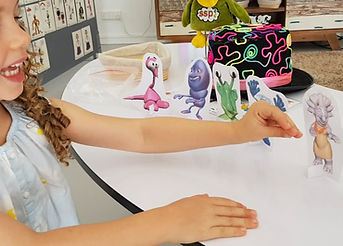


This technology is used to support Activity 2 of Speedie Readies and the use of the One, Two, Three and Away series of one hundred readers. These books take children from single-word decoding and encoding to self teaching, and then reading with fluency, vocabulary knowledge, and comprehension.
Most of reading is acquired through implicit processes, but the quality of the explicit instruction that kick starts this process matters. Children build most of their word knowledge through implicit statistical learning and self teaching once they can decode (Share, 1995). However, at risk children only reach the self teaching phase if the explicit instruction they receive is strong enough to establish accurate phoneme–grapheme mappings and support early decoding (Ehri, 2005, 2014; Castles et al., 2018). High quality explicit bi directional phonics instruction lays the foundation that allows implicit learning to take over, so weaknesses in early teaching can delay or prevent the transition into efficient independent reading.
Whole class synthetic phonics is not enough for the one in five at risk. These children need to be shown the code and to experience word mapping in both directions, without being restricted to the core code of around 100 GPCs that is typically covered in class. This content is necessarily limited and delivered through a one size fits all approach because of the realities of whole class teaching.
Speedi Readies offers a solution that is of greatest benefit to children who do not independently start self teaching with a whole class phonics programme, and who often become aware of their struggle before anyone intervenes.
The TA will guide children to use the technology. As part of the pilot, they will also teach children how to use the MyWordz® app independently in class. Children can say any word to see the spelling and grapho phonemic structure, or type any word they cannot decode and view the structure. This means that during reading and writing in class, children can use the technology to work independently.
It matters that children can see the grapho phonemic structure because the technology shows the structure of all words, not just the grapheme phoneme correspondences that are taught in a synthetic phonics programme. English contains more than three hundred and fifty correspondences, far beyond the one hundred or so that are covered in validated programmes. By showing the complete structure for any word a child wants to read or write, the app makes the full alphabetic code visible. This helps children understand how sounds and letters connect across the entire orthography, not only within the restricted set taught in class. This is especially important for hildren a risk of reading and spelling difficulties, and when used in class within Reception and Year 1 prevents the dyslexia paradox.
It can also be used as a one-screen AAC.


We 'Show the Code' for the first 52 books in the One, Two, Three and Away! series. Learners use the tech if needed.
When starting the Blue Platform Readers children will use the tech as and when needed.
The books are presented in regular text. They are now self-teaching.
All words can be mapped, and our resources show every correspondence, but real progress happens when these elements come together in connected text.
This is why children move through the series of around one hundred One, Two, Three and Away! books.
They build wider reading skills, including recoding and set for variability, while gaining confidence through meaningful stories.
These books are incredibly powerful for motivating children to talk, explore language and want to read more, and it is hard to describe the impact until you see it yourself.
